
Audrian Empire
The Audro-Dresch Dual Monarchy
Overview
The Audrian Empire believed in union as a civilizing force
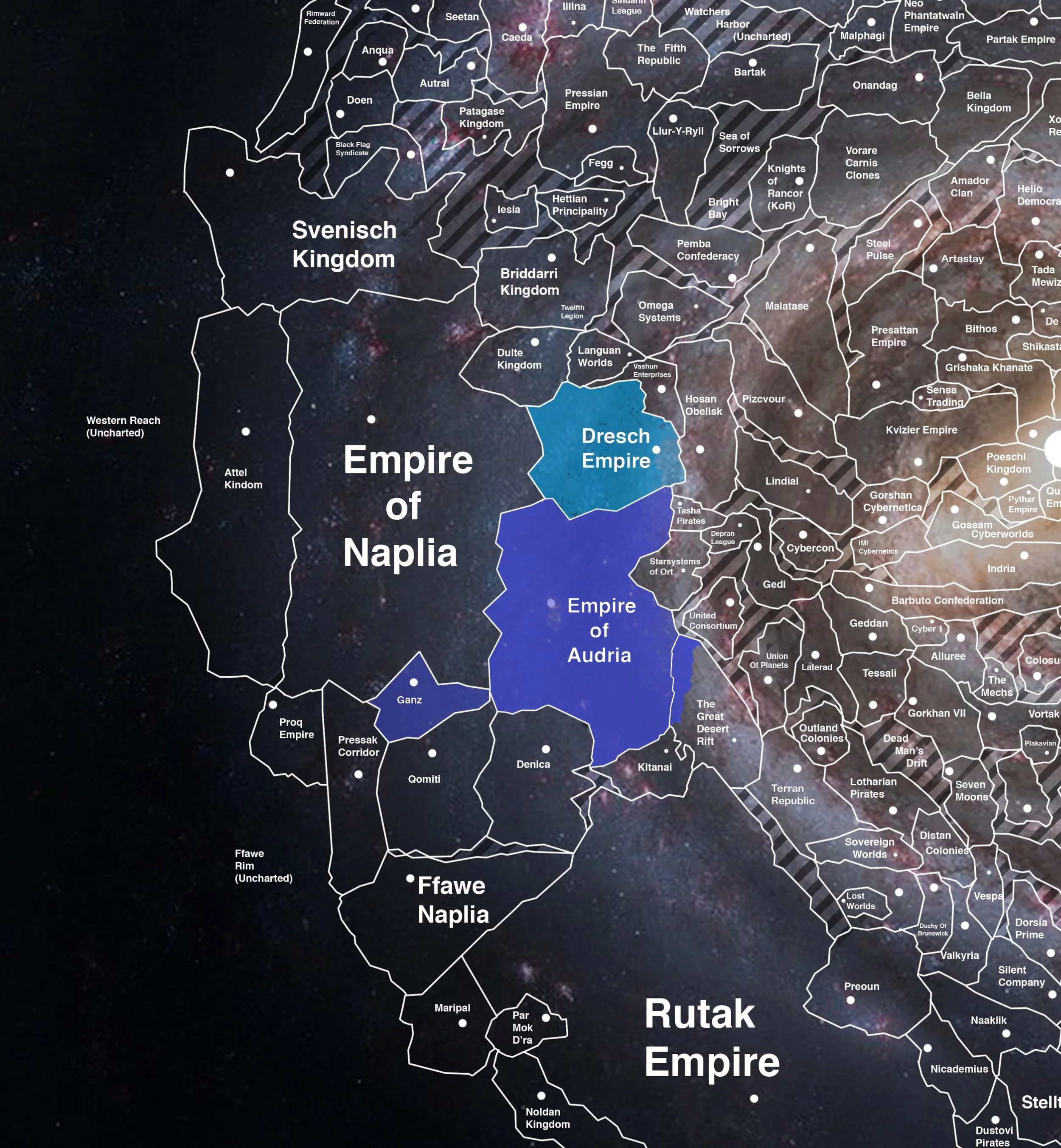
Formally designated the Audro-Dresch Dual Monarchy, Audria emerged in 1346 through treaty rather than conquest, binding the Audrian Empire and the Kingdom of Dresch under the House of Koulan. It was a constitutional arrangement, precise in language and ambitious in scope, intended to reconcile two imperial traditions without erasing either. For nearly fourteen centuries, it succeeded well enough to be mistaken for permanence.
Audria governed by balance.
Power was shared, calibrated between crowns, assemblies, and negotiated autonomy. The Kingdom of Ganz was incorporated not as a subject but as a managed exception—granted internal latitude while remaining firmly within Audrian orbit. This approach became a model replicated elsewhere: influence without annexation, authority without constant enforcement.
At its height, Audria was the third-largest empire in Estra.
Its reach extended deep into the Sudarra and Henshanna star clusters until 2608, where expansion slowed not from defeat but from saturation. Religious accommodation followed political reality. The Destaim faith was formally recognized as an official religion, not as conversion but as consolidation—another system brought inside rather than pushed out.
Industry was Audria’s quiet engine.
Its machine-building sectors and power-apparatus manufacturers ranked among the most advanced in the Rimward Reaches, supplying not only imperial needs but foreign markets that preferred Audrian reliability over imperial ambition. Economic growth followed infrastructure, and infrastructure followed doctrine: modernization as stability, unity as process rather than sentiment.
Audria sat astride the Rimward trade arteries, unavoidable and indispensable. Its population reflected this position—diverse, mobile, and conditioned to coexist within layered governance that rarely resolved contradiction, only managed it.
The empire endured because it did not demand uniformity.
It demanded participation.
For centuries, that distinction held.
And then the pressures that had once been absorbed—religious difference, regional ambition, external war—began to accumulate faster than the system could redistribute them. The dual monarchy did not fail suddenly.
It discovered, too late, that balance is not the same as resilience.
Civil Structure
The civil structure of the Audro-Dresch Empire was built to reconcile difference without resolving it
Governance operated through dual institutions. Audria and Dresch each retained their own parliaments, legal traditions, and internal policies, bound together by a joint Ministerial Council chaired by the monarch. This council controlled the matters no empire could afford to fragment—diplomacy, military command, and imperial finance—while leaving regional fiscal systems largely intact.
The arrangement preserved legitimacy by allowing variance.
Audria emphasized territorial self-rule. Communes exercised wide autonomy over local governance, taxation, and civic order, reinforcing a culture of participation that resisted overt centralization. Dresch followed a more hierarchical model, divided into municipalities administered by appointed officials supported by advisory councils. Authority there was explicit, bureaucratic, and enforceable.
The system worked because neither side attempted to imitate the other.
Capital cities reflected this balance. Wassh and Kal-Raddab functioned not merely as seats of power but as economic engines, anchoring trade, finance, and industrial coordination across the empire. A shared currency facilitated integration, smoothing exchange without erasing regional practice.
Trade was the empire’s quiet stabilizer.
Positioned astride critical Rimward-to-coreward corridors, Audria converted geography into revenue. Routes enriched both crowns, reinforcing the logic of union even when politics strained it. Commerce moved more reliably than consensus.
Longevity came at a cost.
By preserving autonomy within a unified framework, the empire accumulated complexity faster than it shed it. Administration became layered, procedural, and slow to adapt. Oversight existed everywhere and authority nowhere absolute.
The dual monarchy endured not because it eliminated contradiction,
but because it learned to manage it—
until management itself became the burden
Military
The Audro-Dresch military was built on scale mistaken for security
Service was universal. Conscription fed a joint imperial army supported by distinct Audrian and Dresch formations, each preserving its own traditions, command cultures, and internal loyalties. A common Minister of War coordinated these forces beneath the formal supremacy of the monarch, translating political balance into military structure.
At full mobilization, recruitment reached 103 trillion personnel annually, apportioned by population and obligation rather than strategy. The system functioned because it had to. Replacement was assumed. Attrition was planned for.
Industry made this possible.
At its height, the empire maintained more than 56 million warships, a fleet measured not by elegance but by throughput. Hulls were produced, armed, deployed, and lost in numbers that reflected Audria’s industrial dominance and its belief that defense was a matter of endurance rather than decisive victory.
For a time, this assumption held.
But the same structures that sustained scale proved vulnerable to fracture. Nationalist unrest, labor strikes, and regional resistance eroded cohesion during the Naplian Wars. Supply chains slowed. Recruitment faltered. Units remained vast, but loyalty thinned unevenly across the empire.
War accelerated what politics had delayed.
During the Emperor’s War, the military’s size could no longer compensate for divided purpose. Command became reactive. Strategic initiative slipped away. In 2827, the last monarch was captured, and with that act the dual monarchy ceased to function as a unified command authority.
The empire fell.
The arsenal remained.
Audrian military legacy endures not in victory, but in method—strategic depth, industrial warfare, and doctrines designed to sustain conflict at unimaginable scale. It defined what Rimward powers believed possible.
It also demonstrated the limit of that belief:
that numbers can replace unity—
until they cannot.

A common minister of war oversaw military affairs under the supreme authority of the monarch. The empire fielded over 56 million warships at its peak, reflecting its industrial strength and commitment to defense. Nationalistic unrest and labor strikes weakened the military during the Naplian Wars, accelerating the empire's collapse. The Emperors’ War culminated in the monarchy’s defeat, with the last monarch captured in 2827. Despite its decline, the military’s legacy was marked by strategic innovations and a vast arsenal that defined its prominence among Rimward powers.
Dresch Patrol
Special Technologies
Audrian technology was never ornamental
It was systemic.
The empire’s strength lay in industrial depth rather than singular invention. Its aeromotive sector alone sustained more than five hundred manufacturers, with firms such as Audro-Daier and Dresch-Ganz reshaping civilian and military transportation alike. Movement became cheaper, faster, and more predictable—an advantage measured not in speed, but in volume.
Starship production followed the same logic.
The launch of Edar in 1509 marked the beginning of continuous naval manufacture rather than a discrete program. Over centuries, this effort expanded into an arsenal of scale unmatched in the Rimward Reaches. By its height, Audria fielded more than 56 million warships, produced through standardized hull lines optimized for rapid construction and replacement.
Quality was not abandoned.
It was distributed.
Dresch engineering specialized in structural reliability and power efficiency, most notably in the Comitra-class cruisers, whose durability made them fixtures of long-duration fleet actions. Audrian industrial hubs, meanwhile, advanced power generation, fabrication systems, and heavy manufacturing, ensuring that loss could always be compensated by output.
Military and civilian technologies evolved together.
The same infrastructure that produced fleets powered cities, automated logistics, and sustained interstellar commerce. Industrial prosperity reinforced political stability—for a time—by making disruption expensive and delay unacceptable. Technology became the empire’s quiet argument for unity: participation ensured access.
Dominance followed naturally.
Audria did not out-innovate its rivals through secrecy or sudden breakthroughs. It overwhelmed them through capacity, refinement, and persistence. Its machines worked because they were built to be built again.
In the end, that proved insufficient.
Technology sustained the empire’s reach and wealth, but it could not reconcile divided purpose or arrest political fracture. The machines endured longer than the monarchy that commanded them.
Audria proved that industry can support an empire for centuries.
It did not prove that it can hold one together forever.
Legacy
The Audro-Dresch Empire did not fall from weakness.
It failed in stages.
In 2724, the dual monarchy ended—not in conquest, but in exhaustion. The constitutional balance that had sustained Audria for centuries fractured under pressures it could no longer redistribute. Parliaments dissolved into emergency rule. Autonomy hardened into resistance. What survived was no longer a union, but a shell.
Authority did not disappear.
It condensed.
For another century, Audria endured as a centralized imperial remnant—military-driven, industrially potent, and increasingly coercive. The systems built to manage balance were repurposed to enforce compliance. Fleets still launched. Factories still produced. But legitimacy had already expired.
The end came in 2827, with the capture of the last monarch during the Emperor’s War. With that act, Audria ceased to exist as a sovereign power. What remained—doctrine, industry, and institutional habit—was absorbed by successors who inherited the machinery but not the mandate.
Audria’s legacy is not ruin, but demonstration.
It proved that union can endure difference, that industry can sustain empire, and that balance can govern vastness—
until balance is mistaken for resilience.
Audria did not adapt when adaptation was required.
It endured as it was, long past the moment when endurance was enough.
History did not erase Audria.
It moved on—
and left the equilibrium behind.

Audrian Infantry


Capital systemCyriac Starsystem
Largest system
Xanil Starsystem
Official
languages
Audrian, Dresch, Dulte, Brid, Onwey Cresh, Common Tradespeak
Ethnic groups
Audrian, Dresch, Dulte, Denic, Qomiti, Kitanai, Ganzian, Rutak, Proq, Onwey
Religion
Destaim, Kulotic, Potesian, Shava, High Shava, Peritan
Government
Imperial
Legislature
Struffa
Upper house: Kola
Lower house: Proveria
Number of
Starsystems1,163,924,773
Audria 878,420,521 starsystems
Dresch 265,554,332 starsystems
Ganz Protectorate 19,467,328 starsystems
Great Desert Rift Colonies 482,592 starsystems
Currency
Librat, Alent, Dena, Laba, Radma, Oku