
Lost Worlds
Terran Colonial Power
Overview
The Lost Worlds were named for what they became, not what they were
Officially styled the Republic of Lost Worlds Constellations, they occupied a dense reach of the Terran Southern Arm of Orion—anchored by the Lost Light Nebulas, the principal Lost Worlds constellations, and a scattering of lesser stellar clusters whose names changed more often than their loyalties. Gariue served as the capital system, though “capital” in this context meant administration rather than authority.
They were vast.
They were crowded.
They were never unified.
Colonized early by the Terran Empire, the region filled rapidly, drawing migrants, dissidents, and opportunists in numbers that outpaced governance. By the time independence was secured following the First Consular War, the Lost Worlds contained one of the largest human populations in known space—measured not only in scale, but in complexity. Cultures overlapped without blending. Identities accumulated without resolving.
Independence did not stabilize them.
It exposed them.
The new republic inherited borders without cohesion and institutions without legitimacy. Central authority existed, but only where it was tolerated. Local power structures—corporate blocs, planetary councils, militia governments, and charismatic autocrats—rose to fill the gaps left by distance and distrust. Separatist movements were not anomalies; they were recurring features.
The Lost Worlds were never conquered outright.
They fragmented.
Their history is less a sequence of regimes than a record of continual realignment—coalitions forming, dissolving, and reforming under pressure. Autocracy emerged not as ideology, but as a response to exhaustion. Order was imposed where consensus failed, and withdrawn when it became too costly to maintain.
In the end, the name proved accurate.
The Lost Worlds were not lost to ignorance or neglect, but to scale without coherence. They demonstrated that population alone does not produce strength, and that independence without integration invites a different kind of collapse—one that arrives slowly, unevenly, and without a single moment to mark its beginning.
They were not forgotten.
They simply never finished becoming whole.
Civil Structure
The civil structure of the Lost Worlds never settled long enough to harden
They began as a Terran colonial administration, governed at distance and tolerated at scale. Independence after the First Consular War replaced external authority with internal contest. The republic that followed existed in law more than in practice, its democratic forms strained by population density, economic disparity, and a chronic absence of shared identity.
Politics fractured along occupational and regional lines. The rise of the Farmers and Workers movement marked the first attempt to impose coherence through mass appeal rather than institutional legitimacy. It failed without collapsing, giving way to the Separatist Party, which formalized fragmentation as policy. Neither movement resolved the underlying tension. Both deepened it.
Governance became cyclical.
Periods of representative rule alternated with autocratic consolidation, each justified as a corrective to the last. Strongmen promised order. Councils promised inclusion. Neither endured. External pressures—from neighboring empires, trade powers, and military rivals—exploited these transitions, applying influence where authority was weakest.
Economic continuity outlasted political stability.
Nodes such as the Elel Orbital Trade Hub anchored the region’s viability, sustaining commerce across three major interstellar routes regardless of who claimed to govern. Trade flowed even when law did not. Markets adapted faster than institutions ever could.
Socially, the Lost Worlds retained deep agrarian roots, even as urbanization and industrialization accelerated during periods of relative calm. Rural populations fed megacities that never fully governed them in return. Industry expanded without integrating the societies that supported it.
The result was not collapse, but permanent imbalance.
The Lost Worlds were governed, repeatedly.
They were never governed together.
Military
The Lost Worlds never built a military to win wars
They built one to endure them.
Defense was prioritized over projection, shaped by the expectation that threats would arrive from every direction and for different reasons. Planetary defense grids, hardened population centers, and dispersed orbital installations formed the backbone of their strategy. Facilities such as the Elel Orbital complex served multiple purposes at once—trade nexus, logistics hub, and, when required, a blind spot where smuggling and unofficial movements were tolerated as a form of economic pressure relief.
Military action was almost always reactive.
External threats—from Terran intervention forces, Reittian pressure, and opportunistic neighbors—overlapped constantly with internal revolt. The Lost Worlds became adept at fighting themselves while preparing to be fought by others. Guerrilla warfare emerged not as doctrine but as inevitability. Uprisings like Dmitry Borshin’s revolt and the prolonged Nine Decades’ War were not exceptions; they were the operating condition.
The most decisive campaigns came not from the Lost Worlds, but against them.
General Vasilyi Cormanov’s intervention marked the most catastrophic attempt to impose order. Terran forces under his command abandoned counterinsurgency in favor of eradication. Rural populations were forcibly relocated into so-called “recentralization worlds”—concentration camps by any other name—while rebel infrastructure was dismantled systematically and without restraint. Civilian losses reached into the hundreds of billions, a scale of destruction that erased entire cultures rather than suppressing resistance.
Order was restored.
Authority was not.
The campaign shattered populations but failed to extinguish defiance. Resistance fractured, went underground, and reemerged in altered forms. The Lost Worlds rebuilt because they had no alternative. Survival was not triumph. It was habit.
Their military history is not a record of victories or defeats.
It is a record of what happens when suppression replaces governance—and still does not succeed.
The Lost Worlds learned how to resist occupation long before they learned how to prevent it.
Special Technologies
Lost Worlds technology developed where control failed
Its most consequential systems were not weapons or fleets, but movement infrastructure. Foldgates defined the region’s reach and its contradictions—official arteries of commerce alongside corridors that existed only by tolerance or neglect. The most infamous of these, the diamond-shaped foldgate known as Edaminla, operated outside formal authority altogether, maintained as a smuggling conduit by the Ranga gang. It functioned not because it was hidden, but because too many interests benefited from its continued existence.
Mobility became leverage.
Foldgate access allowed rapid transit across contested space, enabling evacuation, supply diversion, and clandestine operations that formal militaries could neither regulate nor fully suppress. Control of gates mattered more than control of worlds. Where gates remained open, resistance persisted.
Civil technology followed the same adaptive logic.
Agricultural systems were redesigned to sustain population density rather than rural stability, shifting from feudal colonial models into industrialized, high-yield production networks. Urban planning emphasized vertical expansion, modular habitation, and rapid reconstruction—cities built to absorb unrest, damage, and displacement without collapsing outright.
These systems sustained one of the largest populations in known space, not comfortably, but continuously.
Innovation in the Lost Worlds was rarely elegant. It was practical, often improvised, and frequently compromised by corruption or violence. Yet it allowed a fragmented society to function at scale long after cohesion had failed.
The Lost Worlds did not advance technologically to dominate space.
They advanced to remain inhabitable.
Their greatest achievement was not progress, but persistence—maintained through systems that blurred legality, ignored ideology, and survived precisely because no single authority could claim them.
Legacy
The Lost Worlds did not fall in a single war
They were consumed by duration.
Independence brought neither unity nor peace. Each generation inherited the fractures of the last—separatism layered atop repression, resistance answered with atrocity. By the late 38th century, the Republic of Lost Worlds Constellations no longer functioned as a coherent polity. It existed as an argument carried by force.
The final decades were defined not by conquest, but by attrition. Population transfers, recentering campaigns, and counterinsurgency wars hollowed entire systems. Trade routes collapsed into smuggling corridors. Orbital hubs went silent one by one. By 3879, no central authority remained capable of issuing orders that mattered.
There was no final capital to seize.
No declaration to archive.
Only a widening absence.
What survived were fragments: displaced populations absorbed elsewhere, industrial relics stripped and repurposed, and stories of a republic that had once tried to govern diversity through law rather than fear.
The Lost Worlds are remembered not for how they ended, but for how long they resisted ending.
They proved that scale alone does not guarantee stability, that population is not the same as cohesion, and that brutality can suppress rebellion without ever resolving it.
In the end, the Lost Worlds did not lose because they were weak.
They lost because they were never allowed to become whole.
History records their fall in 3879.
The vacuum they left persisted far longer.

Lost Worlds CDF Troopers
Colonial Defense Forces


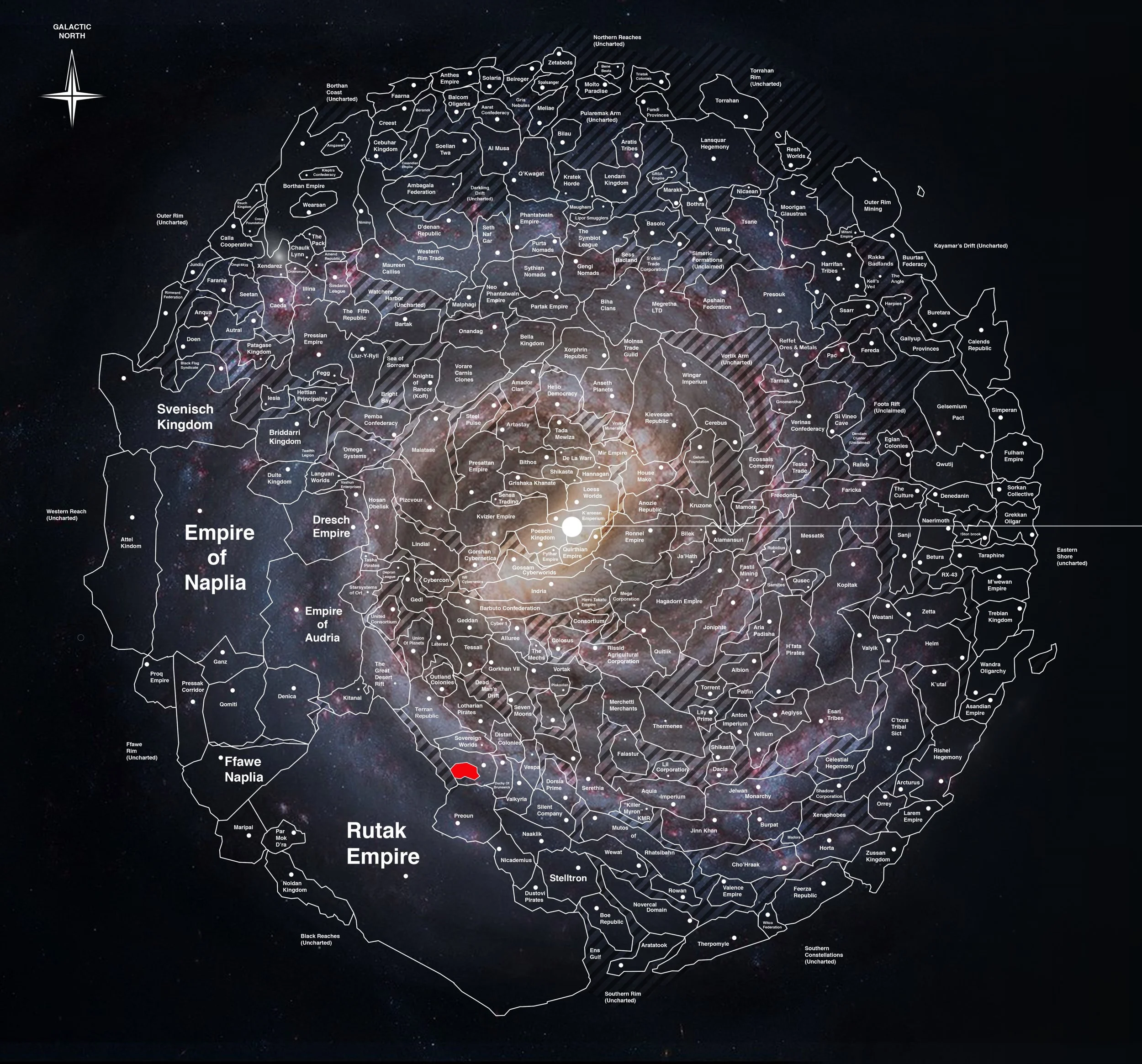
Capital SystemElel Starsystem
Largest System
Elel Starsystem
Official
languages
English, Russian, Cantonese Common Tradespeak
Main Species Human (Radnian)
Religion
Deism, Christianity, Islam, Buddhism, Hinduism, Ammanianism
Government
Colonial Republic
Legislature
Colonial Senate and House of Representatives
Number of
Starsystems 5,378
Main Currency
Terran Credit
Accepted Currencies
Alent, Sater, Sulad, Librat, Oku, Minat, Paprita