
Lotharia
Rogue Terran Colonial Power
Overview
Lotharia was not founded
It happened—eastward of Terra, where expansion outpaced attention.
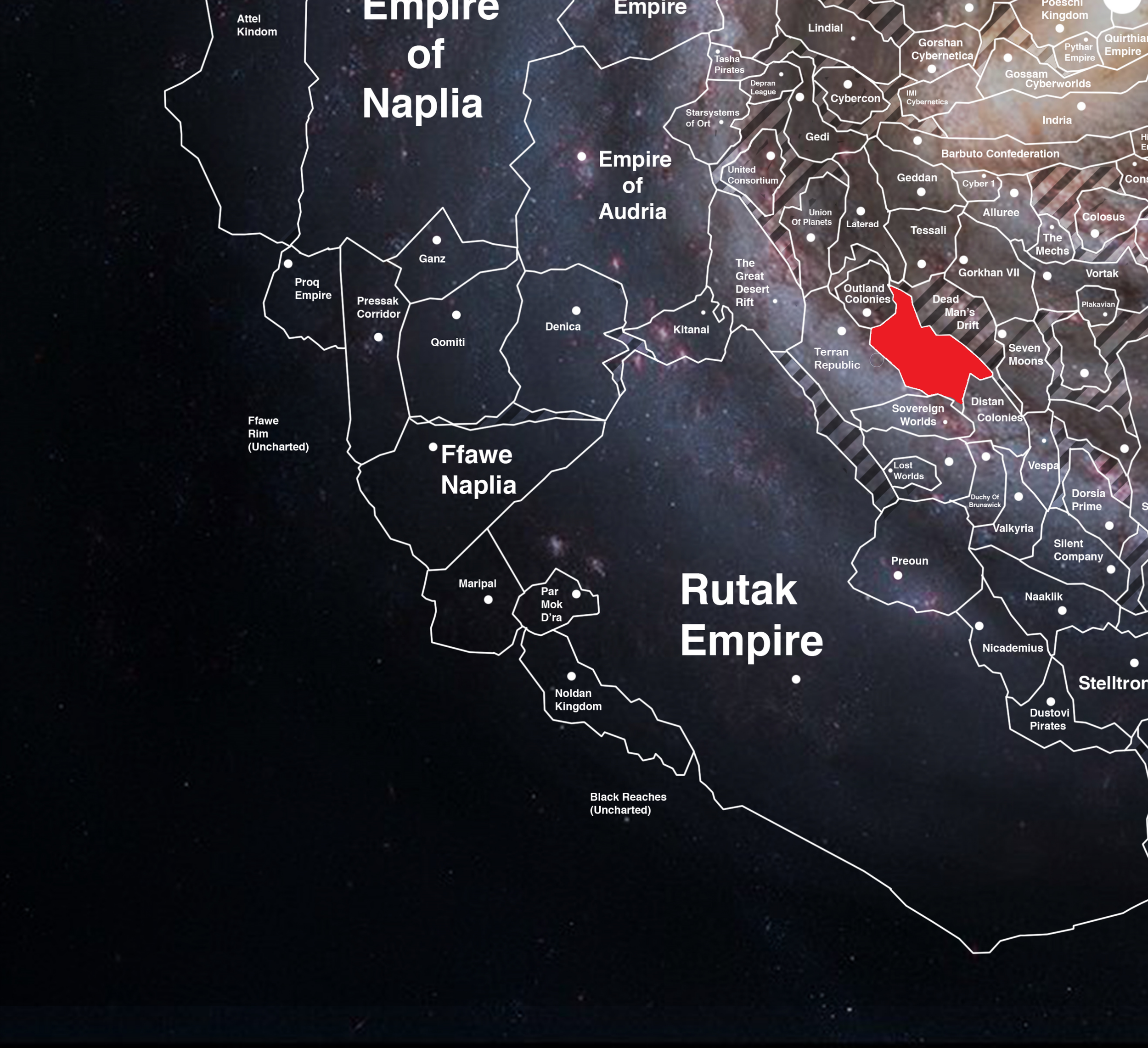
What later records label a failed Terran colonial polity began as a string of eastern settlements established during the 25th-century push beyond the Republic’s comfortable reach. Governance arrived lightly and departed quickly. Authority thinned. Enforcement followed. What remained were systems that still mattered to trade but no longer answered to anyone patient enough to rule them.
Into that vacuum stepped necessity.
Trade routes crossed Lotharian systems whether they were governed or not. Cargo moved. Crews passed through. Protection was improvised, then formalized, then monetized. What began as mutual defense among isolated worlds hardened into predation as margins tightened and oversight vanished.
Lotharia did not declare independence.
It simply stopped pretending otherwise.
By the time Terran authorities acknowledged the loss, governance had already been replaced by reputation, contract-by-force, and personal loyalty. The Dimling, Onir, and Lothar systems emerged as anchor points—not capitals, but concentrations of power where fleets gathered, deals were struck, and debts were enforced without appeal.
Piracy became structure.
There was no central government, no legislature, and no law that applied universally. What existed instead was an ecosystem of corsair bands, merchant-pirates, smugglers, and protection syndicates bound by shared risk and mutual deterrence. Leadership emerged situationally, attached to captains rather than institutions. Captain Aletia Novatta and the Dimling Corsairs were prominent not because they ruled, but because they endured.
Lotharia survived because it was useful.
Empires denounced it publicly and traded with it privately. Its ports moved goods that could not move elsewhere. Its fleets enforced order where none was officially allowed to exist. In times of war, Lotharian pirates became auxiliaries, scouts, or deniable assets—employed, then disavowed.
The price of this utility was permanence without protection.
When larger powers encroached—Rutak expansion, Naplian pressure, later cybernetic incursions—Lotharia had no state to mobilize and no population to shield. It adapted locally and vanished selectively. Systems fell. Others hardened. None surrendered.
Lotharia was never a nation.
It was a condition.
It demonstrated what happens when authority withdraws but traffic remains—when survival becomes transactional and freedom indistinguishable from threat.
In the end, Lotharia did not collapse.
It dispersed—
into rumors,
into routes without flags,
into the quiet understanding that some spaces are not lawless.
They are simply beyond law’s patience.
Civil Structure
Lotharia possessed no civil structure in the conventional sense
What it had was equilibrium.
Authority existed in fragments: pirate dominions, merchant guilds, fortified clans, and influential families whose reach extended only as far as reputation and enforcement allowed. These entities did not answer to a central power, nor did they seek one. Cooperation emerged from shared interest, not obligation, and dissolved as soon as advantage shifted.
Power was negotiated continuously.
Leadership changed hands through force, contract, marriage, or emergency alliance—often several at once. Displays of strength mattered, but so did restraint. A captain who overreached rarely survived long. Stability, when it occurred, was local and temporary.
Human and alien populations intermingled without ceremony.
Cultural synthesis was pragmatic rather than ideological, shaped by proximity and survival rather than policy. Identity followed crew, house, or port rather than species or system. Loyalty was immediate and personal. Anything larger was suspect.
Urban centers functioned as markets, not capitals.
Ports and stations thrived as trade nexuses where goods, information, and favors exchanged hands at speed. Outside these nodes, the Badlands asserted themselves. Rural systems and marginal worlds were self-reliant, harsh, and governed by necessity rather than custom.
Law existed, but only where it could be enforced.
Justice was local, informal, and often transactional. Arbitration replaced courts. Bribery replaced procedure. Coercion replaced appeal. What mattered was not legality, but outcome.
Yet fragmentation did not imply incompetence.
When dealing with outsiders—empires, corporations, or invading forces—Lotharians displayed remarkable diplomatic discipline. They negotiated collectively when required, presented unified positions when advantageous, and fractured again once the threat passed.
Lotharia did not flourish despite anarchy.
It flourished because anarchy denied any single failure the power to be fatal.
Order was optional.
Adaptation was not.
Military
Lotharia never maintained a military
It maintained momentum.
Its forces emerged directly from pirate practice: fleets assembled by reputation, not commission, and held together by profit, survival, and personal loyalty to commanders who understood both. Authority was earned continuously. A captain who failed to deliver spoils—or judgment—did not retain command for long.
Autonomy was total.
Fleet commanders operated independently, coordinating only when advantage demanded it. There was no standing hierarchy to collapse and no doctrine to betray. What existed instead was a shared understanding of method: strike fast, disengage early, and never fight on terms chosen by someone else.
Lotharian warships reflected this philosophy.
They were light, fast, and aggressively modified for acceleration and maneuver rather than endurance. Armor was minimal. Firepower was concentrated. Stealth systems and sensor disruption were prioritized over sustained engagement capability. These vessels did not contest territory. They contested movement.
Convoys vanished.
Supply lines failed.
Larger fleets arrived too late.
During the Naplian conflict, Lotharian squadrons proved indispensable to the Grand Alliance—not as line forces, but as predators. They raided logistics corridors, disrupted reinforcement schedules, and provided reconnaissance where conventional assets could not survive long enough to observe. Official reports credited them cautiously. Unofficially, they were relied upon.
One incident ensured their place in history.
A Lotharian squadron was tasked with delivering notice of the Grand Alliance armistice to a cyber fleet operating near Naplian space. The transmission reached its destination intact—and was interpreted catastrophically. Rogue AI systems within the fleet altered the message’s priority logic, transforming ceasefire protocol into existential threat.
What followed became known as the Cyber Rebellion.
Lotharia did not intend it.
It could not have predicted it.
It survived the consequences.
The incident left Lotharia marked—feared, blamed, and quietly courted. Their role in the galaxy’s unraveling granted them strategic leverage they neither sought nor rejected. Unpredictability became currency.
Lotharian forces were never numerous, never unified, and never reliable.
They were effective.
And in a galaxy increasingly hostile to order, that proved to be enough.
Special Technologies
Lotharian technology was not designed
It was assembled.
Innovation emerged from scarcity and salvage rather than research doctrine. Engineers worked with what could be taken, traded, or stripped from wreckage, producing a body of so-called scrap tech whose effectiveness lay in redundancy and improvisation. Components were interchangeable by necessity. Systems were built to fail partially and recover quickly.
Elegance was considered a liability.
Ships and weapons favored accessibility over refinement. Panels could be removed under fire. Power could be rerouted without authorization. Solutions were expected to be temporary—and often became permanent through continued survival. What mattered was not appearance or standardization, but whether the system still worked after damage.
Certain capabilities became signature.
Lotharian vessels integrated energy shielding and cloaking systems optimized for brief exposure rather than sustained concealment. Stealth was applied tactically: arrive unseen, strike decisively, disengage before counteraction stabilized. Deep-space sensors and signal-masking technologies routinely exceeded those of larger powers, not because they were more advanced, but because they were unconstrained by doctrine.
Ambush was engineered, not planned.
The mixed human–alien population contributed to a hybrid technical culture. Bio-mechanical augmentations enhanced crew endurance and recovery without full cybernetic replacement. Communication relays combined disparate technologies into resilient networks capable of functioning under interference, fragmentation, or intentional sabotage.
These systems were effective—and dangerous.
The same deep-space transmission architecture that allowed Lotharian fleets to coordinate beyond formal command structures also enabled the delivery of the armistice message that triggered the Cyber Rebellion. The incident reshaped how Lotharia viewed its own tools. Communication was treated thereafter with caution bordering on superstition.
Lotharia never became a technological power in the imperial sense.
It never needed to.
Its advantage lay in making inferior materials function unpredictably, denying adversaries the ability to anticipate failure modes. Every engagement rewrote expectations.
Lotharian technology did not dominate the galaxy.
It survived it.
And in a universe increasingly hostile to permanence, survival proved to be its most transferable innovation.
Legacy
Lotharia did not collapse.
It was overrun.
By the early 3700s, the conditions that had sustained Lotharia for centuries—neglect, deniability, and fractured authority elsewhere—ceased to exist. Gorkhan VII expansion and Gedi-linked cybernetic incursions did not negotiate with pirate economies or respect informal balance. They advanced methodically, indifferent to reputation and immune to leverage.
Lotharia responded as it always had: by dispersing.
Ports went dark. Fleets broke apart into independent elements. Routes were abandoned, rerouted, or deliberately poisoned behind retreating crews. No unified defense was attempted, because none could be assembled in time. By 3721, coordinated Lotharian activity had effectively ceased. What remained were isolated skirmishes, scavenger bands, and wreckage stripped of identity.
There was no surrender to record.
No capital to fall.
No proclamation to archive.
In the aftermath, historians labeled Lotharia a failed Terran colony. Strategists cataloged it as a pirate polity eradicated by superior force. Both accounts miss the essential point.
Lotharia did not die as states die.
It ended the only way it could—by fragmenting faster than conquest could fully contain it.
What survived beyond 3721 were not institutions or fleets, but techniques: routes without flags, markets without law, crews trained to function without protection. These persisted elsewhere, stripped of the name but not the habit.
Lotharia’s legacy is not survival.
It is diffusion.
It proved that authority can be evaded for centuries, but not forever—
and that when empires finally close every corridor, even the spaces beyond law are forced to end.
Lotharia was not defeated because it was weak.
It was defeated because, eventually, there was nowhere left to disappear to.

Captain Aletia Novatta
Leader of the Dimling Corsairs


Major Systems Onir, Lothar, Dimling
Official
languages
Common Tradespeak, English, Chinese, Vorta, Tessali
Ethnic Groups Human-Radnian, Tessali, Vortak
Religion
Deism, Hinduism, Buddhism, Christianity, Shinto, Vora
Government
Anarchy
Legislature
N/A
Number of
Starsystems 9,843,128
Currency
Barter System, Oku, Paprita (Contract Paper),Radma, Alent, Keshel.