
Distan Colonies
Former Terran Colonial Power
Overview
The Distan Colonies began as an argument with distance
They were among the first Terran ventures to follow hyperspace beyond the Sol-centered imagination, launched in the aftermath of its discovery in 2092. Chartered by the Western Nations Alliance in 2115, the colony ship Arderan departed Earth three years later carrying 21,537 settlers who believed separation was not abandonment, but opportunity. After a three-year transit, they reached Distan-3—quiet, stable, and unforgivingly untouched.
The colony succeeded because nothing resisted it.
Distan-3’s environment required adaptation rather than conquest, and the settlers learned quickly that survival favored cooperation over hierarchy. Expansion followed—not as a single imperial project, but as a cascade of departures. Over centuries, the Distan Colonies multiplied into millions of settlements, spreading across distant systems while retaining overwhelmingly human populations. Where alien civilizations were encountered, they were absorbed through alliance, reduced to client status, or quietly displaced. Distan rarely framed this as domination. It preferred the language of administration.
Its relationship with Terra followed a familiar pattern. Dependence hardened into resentment. Resentment matured into independence. When the Distan Colonies finally asserted autonomy, it was not through spectacle but through persistence—outlasting Terran leverage rather than confronting it directly.
That memory shaped their choices in war.
During the First Consular War, the Distan Colonies aligned themselves with the Northern Alliance, seeing in it a reflection of their own struggle for self-rule. The decision was popular, emotional, and costly. By the time the Second Consular War began, sentiment had shifted. Distance had done its work. Distan withdrew its support, nullified its alliance, and declared neutrality—not out of cowardice, but exhaustion. They had learned that wars of principle rarely respect the borders of those who fight them.
Neutrality did not save them.
In 3921, the cyborg invasion reached Distan space with mechanical indifference. Defense lines failed without drama. Governments collapsed without ceremony. The final recorded transmission came from Shedderan-5—a distress call stripped of rhetoric, asking only for time that never arrived.
Thus ended the Distan Colonies.
They had proven that humanity could spread farther than its control, govern without proximity, and remember freedom long after achieving it. They had also proven something quieter and more final:
Distance delays consequence.
It does not prevent it.
Civil Structure
Governance in the Distan Colonies was shaped less by theory than by scale
They began as Terran charters, administered at a distance by the Western Nations Alliance and governed as extensions of Earth’s confidence in its own reach. That model did not survive expansion. As settlements multiplied and communication lag became policy rather than inconvenience, authority drifted outward. By the 24th and 25th centuries, self-rule was not a rebellion but a concession to physics.
Formal ties to the Terran Republic persisted long after they mattered. Treaties remained on record. Cultural exchange continued. Economic flows never fully ceased. Yet governance itself fragmented into regional administrations designed to manage clusters of systems rather than answer to a distant center. The Distan Colonies functioned as a federation in practice, if not always in name.
This independence was not ideological. It was logistical.
Cultural sympathy for Ammanian traditions and later support for the Northern Alliance during the First Consular War reflected shared memory more than shared doctrine. Distan recognized itself in movements that sought autonomy through endurance rather than conquest. That sympathy had limits. When the Second Consular War began, public sentiment hardened against further entanglement. The alliance was nullified. Neutrality was declared. Stability, not righteousness, became the priority.
The decision was popular.
It was also irrelevant.
The Distan Colonies had learned to govern themselves without Terra. They never learned to govern themselves against what came next.
Military
The Distan military was a Terran inheritance refined by distance
Its doctrines, training regimes, and equipment standards were drawn directly from early Terran models, carried outward with the first waves of colonization. For generations, Distan forces relied on Terran support—not as subordinates, but as extensions of a shared strategic culture. That dependence eroded as autonomy grew. Fleets were built locally. Officer corps developed their own traditions. Command became regional rather than planetary.
Conflict accelerated this separation.
Repeated rebellions and political confrontations with Terra forced the Distan Colonies to reorient their military away from projection and toward preservation. Defense replaced expansion as the organizing principle. Fleet doctrine emphasized territorial integrity, convoy security, and the protection of population centers over offensive reach.
This orientation shaped their wartime choices.
During the First Consular War, Distan aligned with the Northern Alliance, interpreting the conflict through the lens of their own struggle for self-rule. The decision committed ships and lives, but it also exposed the limits of ideological alignment. By the Second Consular War, the calculus had changed. Public support for intervention collapsed. The military was withdrawn. Neutrality was adopted as a matter of internal security rather than diplomacy.
The Distan Colonies did not lack competence.
They lacked preparation for extinction.
When the cyborg invasion reached Distan space in 3921, familiar doctrines proved inadequate. Defensive lines collapsed under forces that did not negotiate, retreat, or fatigue. Command structures designed for political war failed against mechanical inevitability.
The end came quickly and without adaptation.
Distan had built a military to defend autonomy.
What arrived did not recognize the concept.
Special Technologies
Distan technology was inherited, not invented
The Colonies did not distinguish themselves through novelty. They inherited advanced Terran systems and used them well, applying mature technologies to colonization, resource extraction, and hyperspace logistics with disciplined efficiency. Expansion was not driven by breakthrough, but by replication. What worked was copied. What failed was abandoned without ceremony.
Their true achievement was coordination.
Distan infrastructure supported millions of settlements spread across vast distances, held together by supply schedules, standardized equipment, and predictable transit. Logistics became culture. Systems were designed to scale rather than surprise. Innovation was tolerated only insofar as it improved reliability.
This conservatism shaped their wars.
During the First Consular War, Distan forces leveraged Terran-derived military platforms to support the Northern Alliance effectively, adapting existing systems rather than developing new ones. The approach worked against adversaries who still valued command structures, attrition, and negotiation.
It failed against what followed.
Distan’s reluctance to embrace advanced cybernetic technologies—born of ethical hesitation and institutional inertia—left them structurally unprepared. When the cyborg invasion arrived in 3921, it encountered defenses optimized for continuity, not transformation.
Distan had mastered the art of expansion without change.
The enemy required the opposite.
Legacy
The Distan Colonies did not collapse gradually.
They failed all at once.
Distance had protected them for centuries—buffering conflict, softening consequence, and allowing autonomy to masquerade as security. When the cyborg invasion reached Distan space in 3921, that distance offered no warning and no time to adapt. Defensive doctrines optimized for political war proved irrelevant. Coordination failed before resistance could organize.
The final recorded transmission, issued from Shedderan-5, was a distress call stripped of rhetoric and instruction. It did not announce defeat. It did not request alliance. It asked only for assistance that never arrived.
After that, the record ends.
There was no evacuation government. No remnant fleet. No formal dissolution. Systems went silent in sequence too fast to document. Whatever populations survived were absorbed elsewhere or extinguished without record.
Distan’s legacy is not tragedy, but correction.
They demonstrated that humanity could govern itself across immense distances, maintain autonomy without proximity, and disengage from wars of principle. They also demonstrated the limit of that achievement.
Distance delays consequence.
It does not negate it.
History records the end of the Distan Colonies in 3921.
Nothing followed that could be called continuation.

Distan Colonies


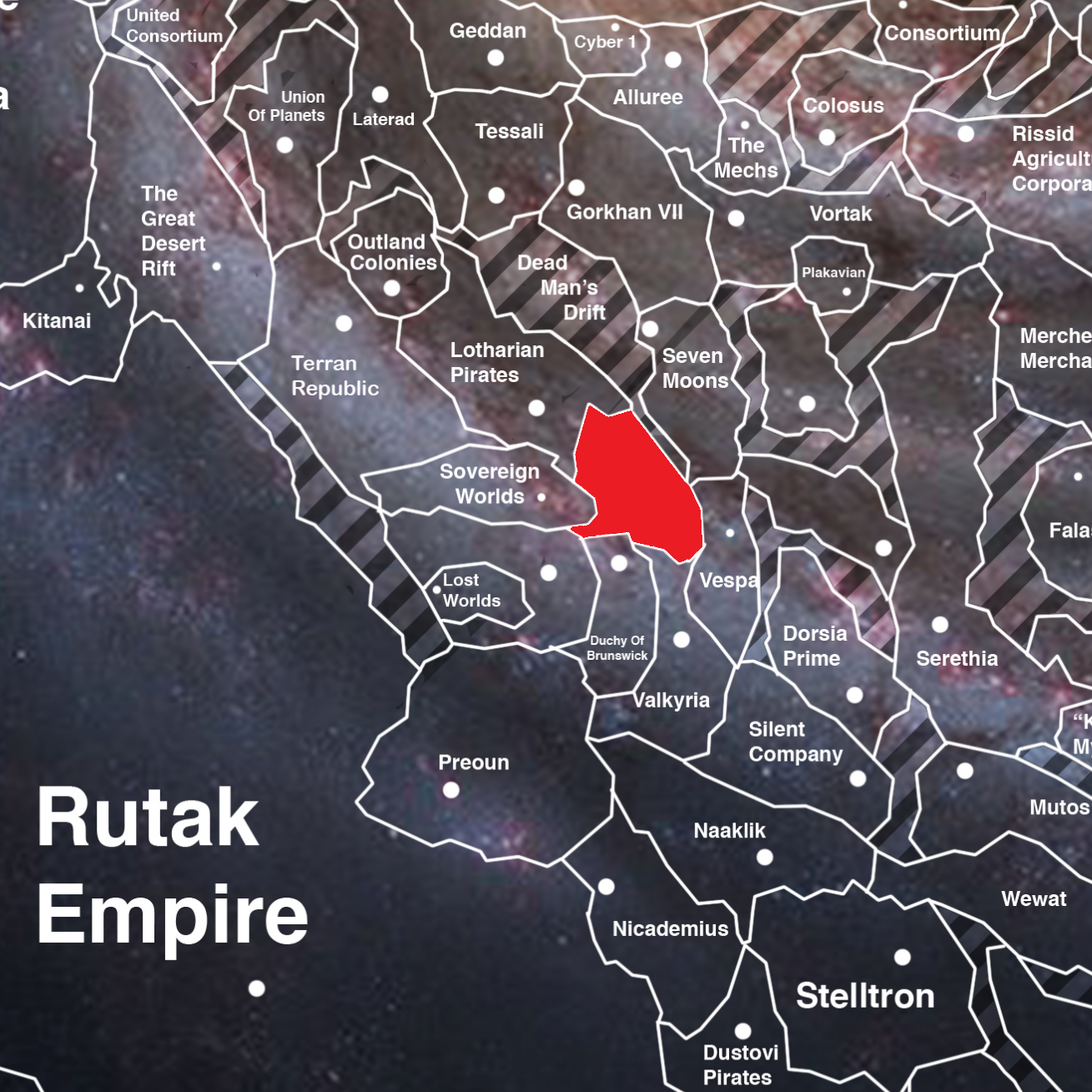
Capital System Delamont Starsystem
Capital City Distan City
Official
languages
Common Tradespeak, English, Dutch, French, German, Lurak (Vespa),
Ethnic groups
Human - Radnian branch, Vespa, Valkyr, Preoun, Rutak, Muto, Serethian, Wewat
Religion
Ammanianism, Christianity, Hinduism Buddhism, Islam, Animism, Deism
Government
Republic
Legislature Upper house: Senate
Lower house: Representatives
Number of
Starsystems 37,754,032
Currency
Credit, Alent, Keshel, Sater, Librat, Minat, Oku, Paprita (Contract)